Reshoring vs. Nearshoring vs. Offshoring: Four Cost Lines Compared
Product managers comparing electronics manufacturing locations often get three separate cases and no single cost view. A low labor rate with offshoring can look like the best choice until inventory, transportation, and other production costs are added.
Avnan already covers each option on its own: reshoring, nearshoring, and offshoring. Those posts talk about the wider trade-offs. Today, we’re going to compare three options on four costs: labor, inventory, transportation, and other production costs.
What reshoring, nearshoring, and offshoring mean
On our manufacturing page, the three options are defined by the factory’s location:
- Reshoring means production in the United States or Canada
- Nearshoring means production in the Americas
- Offshoring means production in Asia
Location sets the cost pattern, but it doesn’t tell you which pattern fits a program.
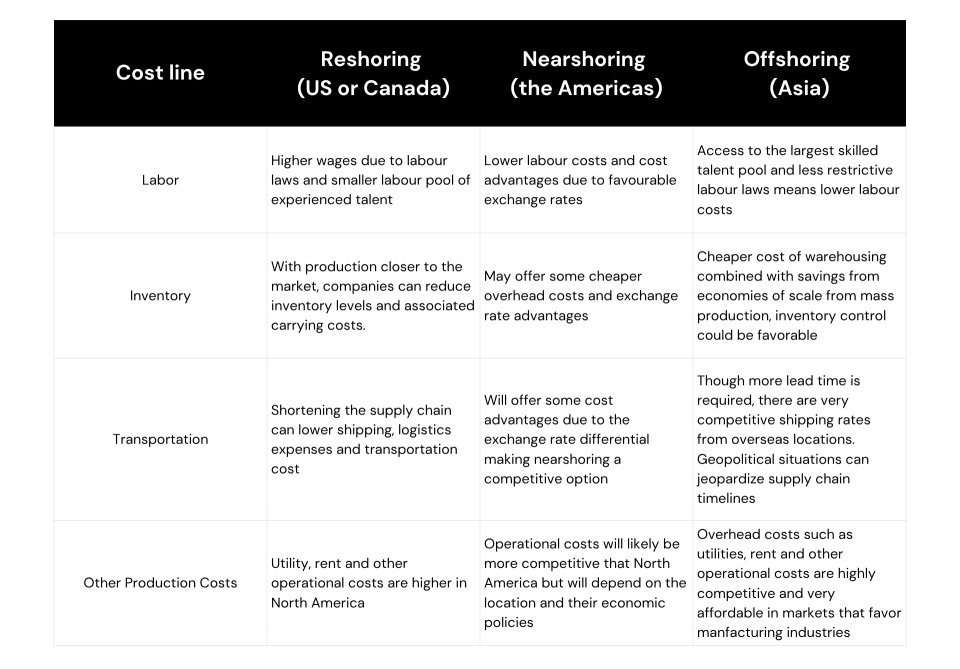
The table below uses the labor, inventory, transportation, and other production costs published on our global manufacturing comparison.
How the four lines compare
Labor – Reshoring has the highest labor costs, because wages are higher and the pool of experienced talent is smaller. Nearshoring has lower labor costs, helped by favorable exchange rates. Offshoring has the largest skilled talent pool, which keeps labor costs low.
Inventory – Reshoring can reduce inventory levels and carrying costs because production is closer to the market. Offshoring can lower warehousing costs, and volume production can make inventory control more favorable. Offshoring also needs more lead time, so goods spend longer in transit.
Avnan can run the same program in the United States or Canada, elsewhere in the Americas, or overseas. A product manager can compare labor, inventory, transportation, and other production costs for that assembly before a factory is chosen, using the location options on Avnan’s manufacturing page.
Transportation. Reshoring can lower shipping, logistics, and transportation costs by shortening the supply chain. Nearshoring has cost advantages from exchange rates, which makes it a competitive option. Offshoring has very competitive shipping rates, but it requires more lead time, and geopolitical situations can jeopardize supply chain timelines.
Other production costs. Utilities, rent, and other operational costs are higher in North America. Nearshoring costs will likely be more competitive than North America, but they depend on the location and its economic policies. Offshoring has highly competitive overhead costs in markets that favor manufacturing industries.
Key Takeaways
- Reshoring vs. nearshoring vs. offshoring is a comparison of four cost lines: labor, inventory, transportation, and other production costs.
- Labor costs are highest for reshoring and lowest for offshoring.
- Reshoring is listed with lower transportation costs. Offshoring is listed with more lead time.
- Utilities, rent, and other operating costs are higher in North America.
- Use the manufacturing options to match a program to a location, then read the single-option posts for the wider trade-offs.
Looking For A Partner?
If you’re looking for a partner to help you build your electronic controls solution, contact us.
Related Posts
What Changes When Electronics Design and Manufacturing Come from One Partner
A launch date moves for reasons that rarely show up in the original plan. The design is done. The factory has the files. Then a part is late, a drawing doesn't match the build, or…
Supply Chain Pressure on U.S. Electronics Buyers, and Where to Source Next
Planning a build is harder when the supply chain no longer prices the way it did two years ago. In July 2026, the average US effective tariff rate was 6.7%, down from the IEEPA spike…
Building a Better BOM – EMS Strategies to Reduce Costs and Lead Times
The electronics manufacturing landscape is a complex environment, with Original Equipment Manufacturers (OEMs) constantly juggling Bill of Materials (BOM) optimization, lead time challenges, and cost control pressures. In an era of global supply chain disruptions…