HVAC Regulations 2025-2026: New Rules, New Opportunities for OEMs – Part 2
This is the continuation of the post on HVAC Regulations 2025: what it is, the challenges, and how you can make it work to your advantage. You can read Part 1 here.
The Challenges: Redesigning for a New Compliance Reality
For HVAC manufacturers, meeting the new regulatory requirements demands rethinking of how their control systems are engineered.
Integrating Refrigerant Leak Detection Sensors
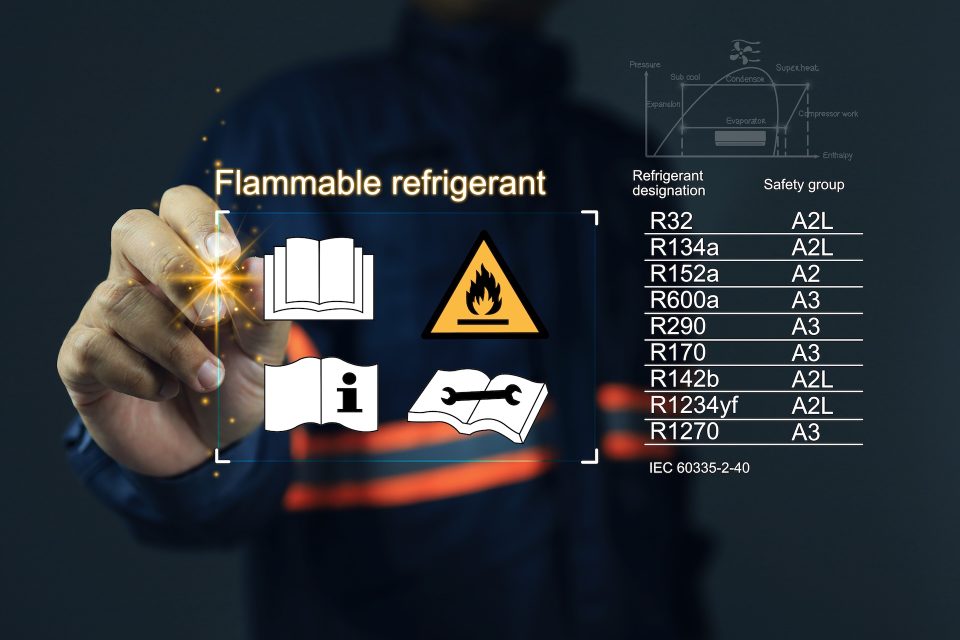
A2L refrigerants require active leak detection built directly into the system. For manufacturers, this means sourcing reliable sensor components, integrating them into existing product architectures, and ensuring they meet the certification thresholds set by UL 60335-2-40 and ASHRAE 15. For procurement teams, it adds a new component category to qualify, source, and manage across the supply chain.
Redesigning for Automated Safety Shutdown Systems
When a refrigerant leak is detected, the system must respond automatically, like shutting down the right components in the right sequence to prevent ignition or exposure risk. Engineering this logic into control boards requires both hardware redesign and firmware development, and must be validated across a range of operating conditions. For OEMs managing multiple product lines, that’s not one but multiple redesigns.
Building in Alarm Monitoring and Fault Diagnostics
Regulators and end users now expect systems to detect problems and communicate them clearly. Alarm monitoring and fault diagnostics must be embedded at the control level, capable of identifying fault conditions, triggering alerts, and logging data for inspection and compliance purposes. For manufacturers, this sets a higher standard on both software sophistication and electronic controls quality. Cutting corners carries regulatory and reputational risk.
These three requirements represent a significant engineering and procurement change that compresses product development cycles and puts pressure on supplier relationships across the board. The good news is that each of these challenges can be turned into opportunities.
The Opportunities: Turning Compliance into Competitive Advantage
Regulatory pressure has a way of distinguishing the companies that react from the ones that take the lead. For those who move decisively, the same requirements driving today’s challenges are quietly opening doors to stronger HVAC products, better margins, and deeper customer relationships.
Variable-Speed Compressor Control
The shift to A2L refrigerants and tighter efficiency standards is accelerating demand for variable-speed inverter technology. For manufacturers, this is an opportunity to move up the value chain. Variable-speed systems command higher price points, deliver better SEER2/HSPF2 scores, and are increasingly what commercial buyers and building operators are specifying. OEMs that build this capability into their product lines now will be ahead of the market
Energy Optimization Algorithms
Meeting SEER2 and HSPF2 standards is about how intelligently a system manages energy consumption across varying load conditions. Manufacturers who invest in sophisticated energy optimization algorithms at the controls level will produce equipment that passes compliance benchmarks and consistently outperforms them in real-world conditions. That performance difference is increasingly a purchasing criterion for commercial buyers focused on operating costs and sustainability targets.
BACnet / Modbus Communication, Cloud Connectivity, and Remote Diagnostics
The new regulatory environment is also pushing HVAC systems toward greater transparency and accountability, and the market is rewarding manufacturers who deliver it. Equipment that utilizes BACnet or Modbus integrates seamlessly into building management systems, making it favorable for commercial and industrial buyers. Cloud connectivity and remote diagnostics take a step further, enabling real-time monitoring, predictive maintenance, and faster fault resolution. These capabilities help reduce downtime for end users and strengthen the value proposition for everyone in the supply chain.
For HVAC OEMs navigating all of this, the right controls partner makes the difference between scrambling to comply and being positioned to lead. Avnan’s expertise in electronic controls for heat pumps, ERV/HRV systems, and OEM HVAC equipment means manufacturers don’t have to build these capabilities from scratch. Instead, they can move faster, with less risk, and with a partner who understands both the regulatory landscape and the engineering demands it creates.
How Avnan can help you?
New refrigerants, plus stricter safety and inspection requirements, have changed what it means to design, build, and supply compliant equipment.
The companies with the most to gain are the ones treating these regulations as a platform to build on. Proactive manufacturers who act swiftly and smartly on product redesign, controls, and supplier partnerships are the ones defining the next generation of HVAC technology while others are still catching up.

As HVAC regulations continue to evolve, Avnan works alongside OEMs and manufacturers to help adapt electronic controls and system architectures to meet new requirements. Our engineering and manufacturing teams support the development of compliant control platforms through control logic validation, firmware updates, safety feature integration, and sensor redundancy for A2L refrigerant applications. By collaborating closely with our customers, we help streamline product redesign efforts and support a smoother path toward regulatory compliance.
Here’s what we deliver as your electronics partner for regulatory compliance:
- Custom HVAC control board design
- Embedded firmware development
- A2L leak detection integration
- Safety certified control platforms
- Smart thermostat architecture
- BAS communication modules
- End-to-end manufacturing and supply chain support
If you’re ready to design HVAC products built for the new regulatory reality, Avnan’s team is here to help.
Key takeaways
- The AIM Act mandates low-GWP refrigerants (R-32, R-454B) for all new HVAC systems manufactured as of Jan. 1, 2025.
- All new installations must be compliant by Jan. 1, 2026.
- Heat pumps, air conditioners, and condensing units must transition to low-GWP refrigerants (R-32, R-454B) and meet updated SEER2/HSPF2 efficiency standards simultaneously. A2L refrigerants require updated safety controls.
- Stricter leak detection and monitoring rules apply to commercial systems.
- OEMs face product redesign, cost increases, and compliance complexity.
- Early movers who partner with experienced controls and manufacturing experts will gain a market edge.
- The right partner accelerates compliance, compresses development timelines, and positions your product line for long-term market leadership.
[1] “The GWP is a measure of how much energy the emission of 1 ton of a gas will absorb over a given period of time, relative to the emission of 1 ton of carbon dioxide (CO2). The larger the GWP, the more that a given gas warms the Earth compared to CO2 over that time period.” – U.S. Environmental Protection Agency
Looking For A Partner?
If you’re looking for a partner to help you build your electronic controls solution, contact us.
Related Posts
HVAC Controls, SKU Sprawl, and Rising PCB Costs
HVAC OEMs are under pressure from rising costs on the same parts used across heat pump, fan coil, and ERV: PCBs, copper, compressors, and motors. Manufacturer price increases stacked through 2026, and electronics suppliers are…
5 Costly Mistakes That Delay HVAC Product Development
Every HVAC OEM engineering team has lived through it: a launch date that looked comfortable six months ago is suddenly at risk, and pointing to a single root cause can get challenging. With decisions made too…
Choosing Between Universal and Custom HVAC Control Architectures
Choosing the right HVAC control architecture is a key decision for OEMs. Should products be built around universal HVAC control architectures or custom electronic control design? Each approach influences cost, performance, manufacturability, and long-term support. Understanding the trade-offs helps…